Dissecting Kinetic Energy Flows in Elite Discus Throws Using Frame-Overlaid Archives
Written by Anna Albrecht · Jul 9, 2026
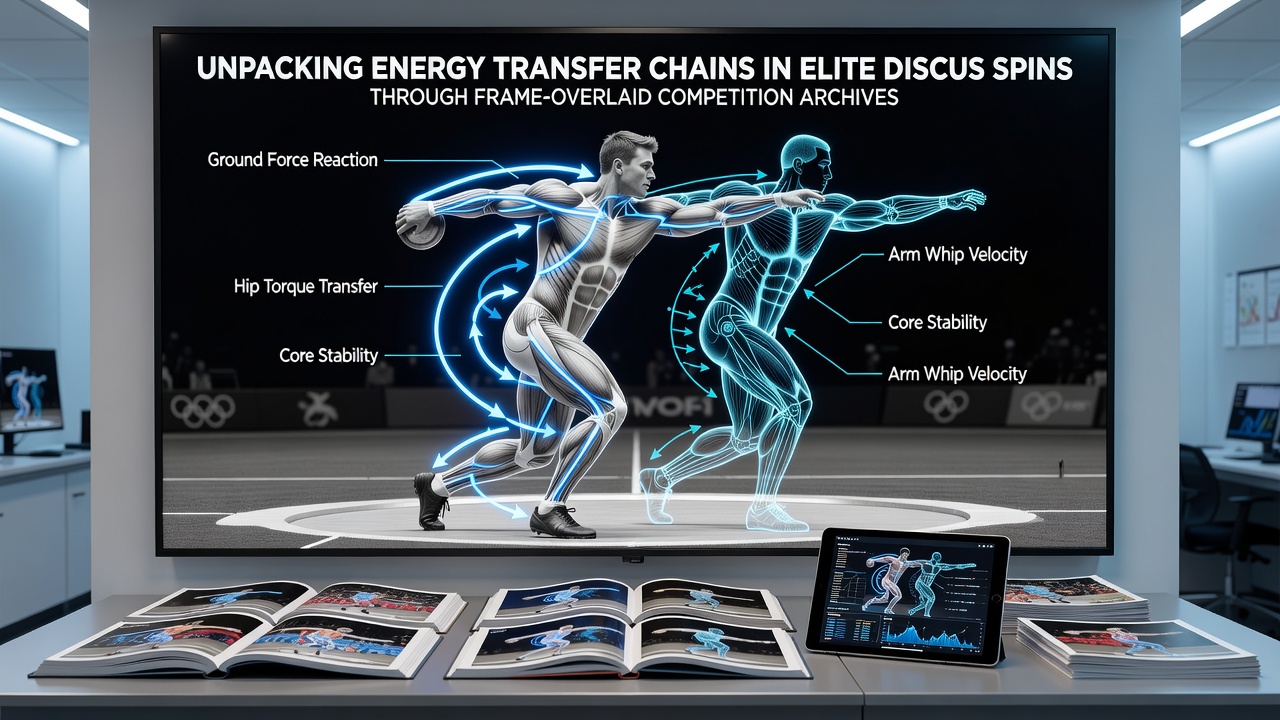
Dissecting Kinetic Energy Flows in Elite Discus Throws Using Frame-Overlaid Archives
Elite discus throwers generate power through sequential energy transfers that begin in the lower body and move upward through the torso into the throwing arm, and frame-overlaid competition archives allow researchers to map these pathways with precision by layering motion data over high-speed footage. Studies from biomechanics labs indicate that the process starts with ground reaction forces during the initial wind-up, where athletes plant the feet to create torque that rotates the hips ahead of the shoulders. Data from international meets shows this hip-shoulder separation stores elastic energy in the core muscles, which then releases during the spin phases to accelerate the discus.
Phases of Energy Transfer in the Discus Spin
The delivery sequence breaks into distinct stages where energy builds and shifts without loss at each junction, and observers note that frame overlays highlight timing differences between successful throws and those that fall short. In the first phase athletes establish a wide base while turning the hips, and this action channels force from the legs through the pelvis into the trunk as confirmed by motion capture comparisons at major events. The second phase involves the single-support spin where the non-throwing side leg drives rotation, transferring momentum forward while the upper body remains coiled to preserve stored energy.
Researchers have documented how the final double-support position before release converts rotational kinetic energy into linear velocity at the hand, and this conversion depends on precise sequencing that frame analysis reveals through velocity vectors overlaid on each joint. Competition archives from World Athletics events demonstrate that top performers maintain continuous energy flow by avoiding pauses between phases, whereas less efficient throws show momentary drops in acceleration at the transition points. Figures from recent biomechanical reviews reveal peak discus speeds exceeding 25 meters per second when the chain completes without interruption.
Frame Overlay Methods Applied to Competition Footage
Analysts apply digital overlays to archival video by synchronizing multiple camera angles with sensor data from inertial measurement units placed on athletes during meets, and this technique produces detailed timelines of force propagation. Software tools align skeletal models over the thrower to track angular velocities at the ankles, knees, hips, spine, and shoulders in sequence. The resulting visualizations display energy pathways as color-coded vectors that intensify as power moves upward through the body.
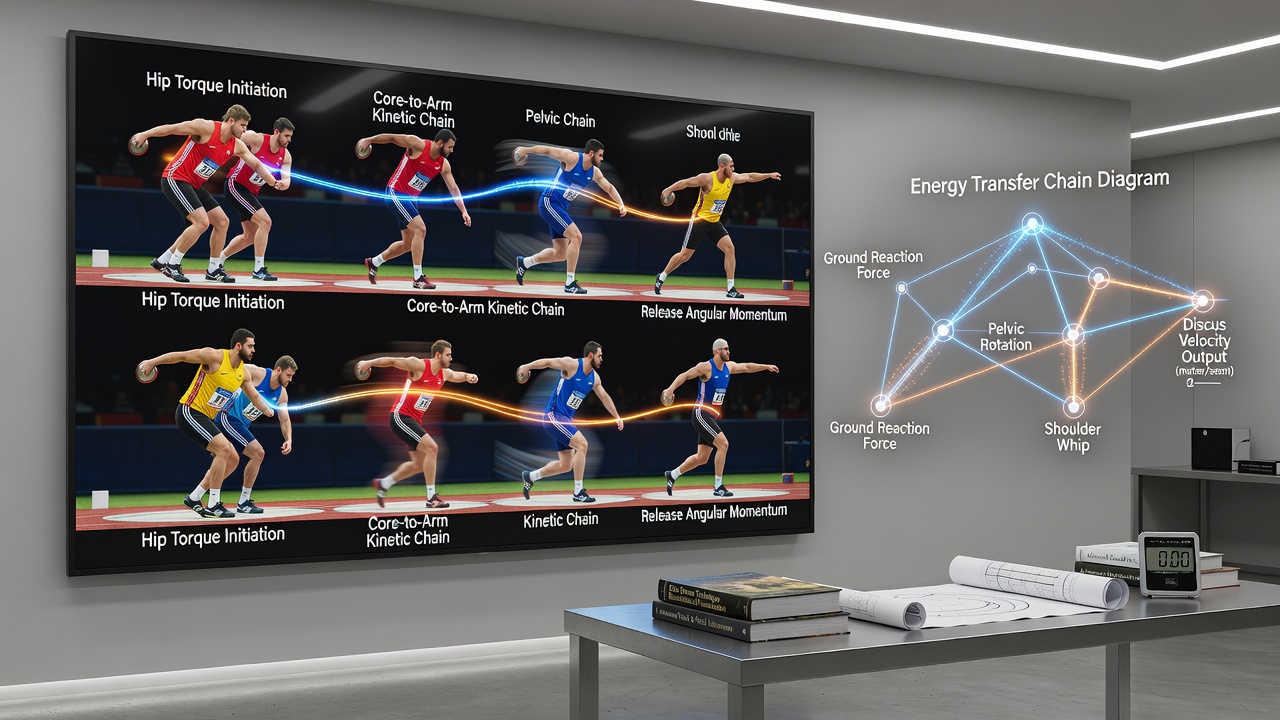
International tournament footage processed this way provides datasets that training centers use to compare an athlete's pattern against elite benchmarks, and reports from the Australian Institute of Sport indicate measurable improvements in release velocity after athletes adjust timing based on such overlays. European research groups have similarly applied the method to footage from continental championships, yielding consistent findings on the role of trunk stiffness in maintaining energy continuity. These archives now contain thousands of throws catalogued by distance and technique type, enabling statistical analysis of common energy leakage points.
Insights from Recent Competition Data
Archives covering events through early 2026 include throws from the previous Olympic cycle and allow direct comparison of energy chain efficiency across different grip styles and spin variations. One pattern that emerges involves the timing of shoulder rotation relative to hip drive, where delays of even 50 milliseconds correlate with reduced throwing distance according to aggregated metrics. Another observation centers on the non-throwing arm's contribution, which researchers track as a counterbalance that stabilizes the torso and prevents premature energy dissipation.
Training programs incorporate these findings by designing drills that emphasize sequential activation, and athletes review overlaid clips to internalize the correct rhythm before attempting full throws. Data collected at training facilities shows that repeated exposure to such visual feedback sharpens proprioception, allowing performers to self-correct during live competition without external cues.
Conclusion
Frame-overlaid analysis of competition archives continues to refine understanding of how energy transfers through the body during elite discus spins, and the resulting datasets support targeted technique adjustments across international training programs. Ongoing cataloguing of new footage ensures that benchmarks evolve alongside advancements in throwing styles and equipment. Those who study these records gain access to objective measures of performance that translate directly into measurable gains on the field.