Frame-by-Frame Breakdown: Shoulder Mechanics in Elite Discus Throwing
Written by Iris Long · Aug 24, 2026

Frame-by-Frame Breakdown: Shoulder Mechanics in Elite Discus Throwing
High-speed video analysis from international competitions continues to show how shoulder torque sequences unfold in discus throwing, and researchers at sports science centers examine these patterns to map the layered mechanics involved. Athletes and coaches review footage from events across continents, breaking down each frame to identify the precise timing of muscle activation and joint rotation that generate release velocity. Data from multiple meets indicate that the sequence begins in the lower body and transfers upward through the core before reaching peak torque in the shoulders during the final delivery phase.
The Rotational Chain and Torque Development
Observers note that discus throwing relies on a coordinated chain where ground reaction forces initiate rotation, and the shoulders act as the final link that accelerates the implement. Studies from the Australian Institute of Sport reveal that shoulder external rotation peaks just before the arm extends forward, creating stored elastic energy that contributes to throw distance. Video from the 2025 World Athletics Championships in Tokyo captured athletes at 500 frames per second, allowing detailed tracking of humeral head movement relative to the scapula throughout the turn.
Coaches often pause footage at specific intervals to compare torque onset across different competitors, and one analysis of Olympic-level throwers showed that elite performers maintain a consistent lag between hip and shoulder rotation of approximately 0.15 seconds. This timing difference allows the torso to coil further, increasing the stretch on shoulder musculature before release. Equipment manufacturers have incorporated similar metrics into training tools that sync with video software used at national training centers in Canada and Germany.
Insights from Global Competition Footage
International meets provide the raw material for these examinations because athletes perform under varying wind conditions and fatigue states that alter torque patterns. Footage from the 2024 Paris Olympics and subsequent Diamond League events demonstrates how shoulder abduction angles shift between qualifying rounds and finals, with many competitors increasing internal rotation velocity by 8 to 12 percent in later throws. Researchers cross-reference these changes with force plate data collected at the same venues to correlate ground forces with upper-body output.
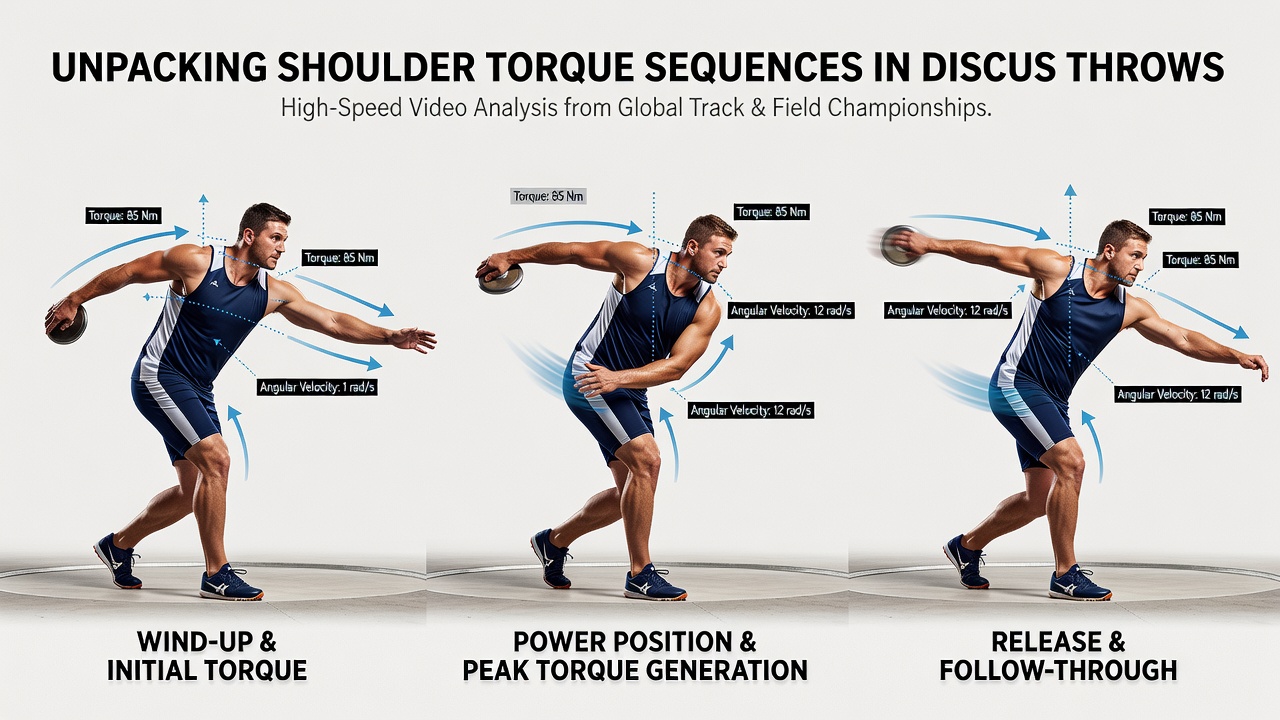
One study published by the European College of Sport Science examined 42 throws from athletes representing 12 nations and found that peak shoulder torque occurs within a 40-millisecond window immediately prior to discus release. This narrow timeframe explains why small variations in timing produce measurable differences in distance. Training groups in New Zealand have adopted synchronized video and sensor systems that overlay torque curves directly onto competition footage, allowing athletes to visualize how adjustments in the power position affect the entire sequence.
Application in Coaching and Athlete Development
National federations integrate high-speed review sessions into regular training cycles, and data from these sessions show consistent improvements in release speed when athletes focus on maintaining shoulder alignment through the transition from single to double support. The International Olympic Committee’s medical commission has referenced similar video-based protocols when discussing injury prevention strategies, noting that excessive early torque correlates with higher rates of rotator cuff strain in longitudinal tracking of throwers. Programs in South Africa and Brazil now include quarterly video audits that compare an athlete’s current mechanics against archived footage from previous seasons.
Technology providers supply cloud-based platforms that allow remote collaboration between coaches in different time zones, and these systems timestamp torque events automatically for quick retrieval during review meetings. Athletes report using mobile applications that flag deviations in shoulder positioning when they upload practice throws, creating a feedback loop that reinforces the patterns observed in global competition footage. Upcoming events scheduled for August 2026 are expected to generate additional high-frame-rate archives that will expand the existing database used for comparative studies.
Conclusion
High-speed video analysis continues to refine understanding of shoulder torque sequences in discus throwing by providing measurable data points that link specific mechanical actions to performance outcomes. Coaches and athletes rely on footage from worldwide meets to identify timing patterns, adjust training protocols, and monitor consistency across competitive cycles. As equipment and software evolve, the precision of these frame-by-frame examinations supports ongoing development in the sport without replacing the foundational role of consistent practice and technical instruction.