Platform Dive Entry Metrics: Insights from Overhead Video Archives in Elite Events
Written by Casey Krause · Jun 13, 2026
Platform Dive Entry Metrics: Insights from Overhead Video Archives in Elite Events
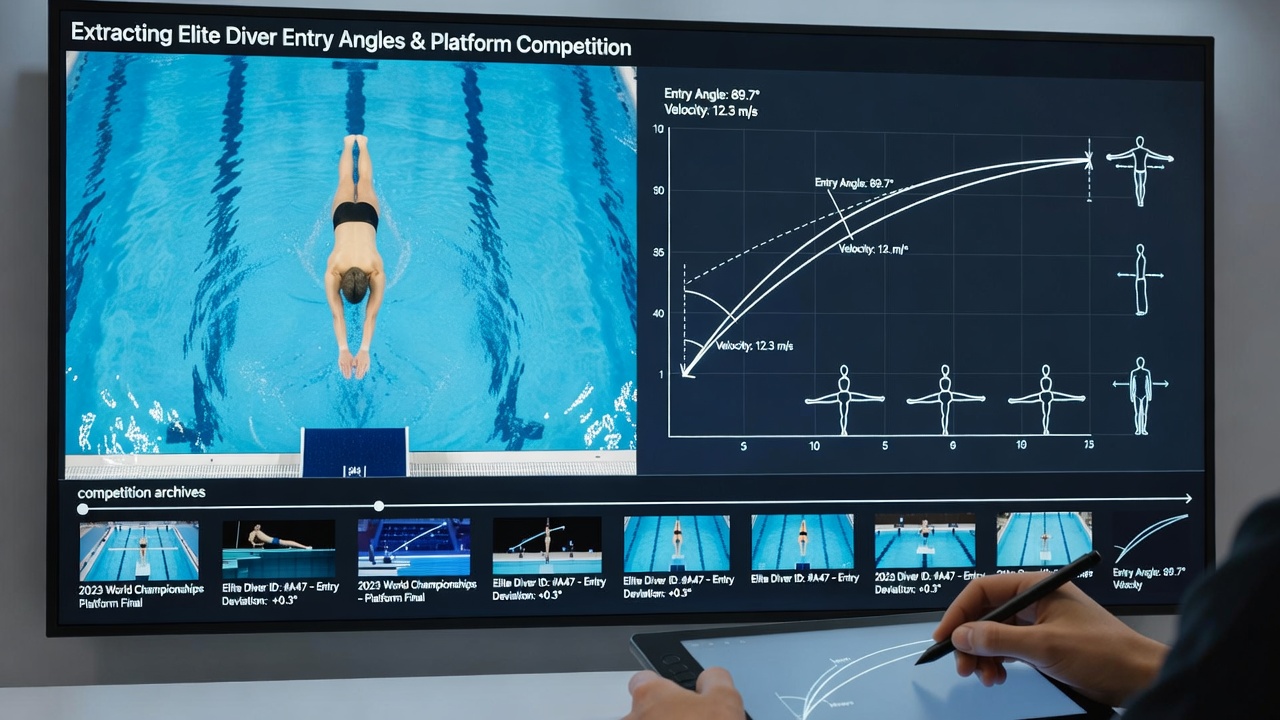
Platform diving analysis relies heavily on archived footage from overhead cameras that capture the precise moment of water entry and this approach allows researchers to quantify entry angles with consistent accuracy across multiple competitions. Analysts examine high-resolution recordings from events such as the World Aquatics Championships where divers execute forward and backward rotations before piercing the surface and the overhead perspective eliminates many of the distortions present in side-angle views.
Technicians import these video files into specialized motion-tracking software that identifies the diver's body axis relative to the water surface at the instant of contact and calculations derive the angle by measuring the deviation from a perfect vertical line which is typically defined as zero degrees. Data sets compiled from several seasons reveal that elite performers maintain entry angles between 4 and 8 degrees on average during forward dives while backward entries often show slightly wider ranges due to the added complexity of rotation reversal.
Data Extraction Methods in Archived Footage
Archival overhead recordings from major meets provide a stable reference frame because the camera position remains fixed above the platform and this consistency supports longitudinal comparisons across years. Software algorithms detect the diver's center of mass and limb positions frame by frame then apply trigonometric functions to compute the entry angle while accounting for minor surface ripples that can shift the apparent contact point by a few millimeters.
Studies conducted by sports science teams at institutions like the Australian Institute of Sport have processed thousands of entries from competitions between 2018 and 2024 and their findings indicate that smaller angle variations correlate with higher execution scores awarded by judges. Observers note that the process requires calibration of camera intrinsics to correct for lens distortion yet once completed the pipeline produces repeatable measurements suitable for technique refinement sessions.
Patterns Observed Across Elite Performers
Review of platform events shows that divers who achieve sub-5-degree entries frequently demonstrate superior control during the final phase of flight and this control stems from adjustments in hip and shoulder alignment initiated milliseconds before contact. Overhead data also highlights how wind conditions at outdoor venues can influence trajectory yet elite athletes compensate through subtle arm positioning that keeps the overall angle within an optimal window.
One study published through the Canadian Sport Institute examined entries from the 2023 Pan American Games and reported that female platform specialists averaged 5.2 degrees while male counterparts recorded 6.1 degrees on comparable dive types and these differences align with variations in body mass distribution and rotational inertia. Analysts continue to cross-reference such figures with scoring databases to identify thresholds that separate medal contenders from the rest of the field.
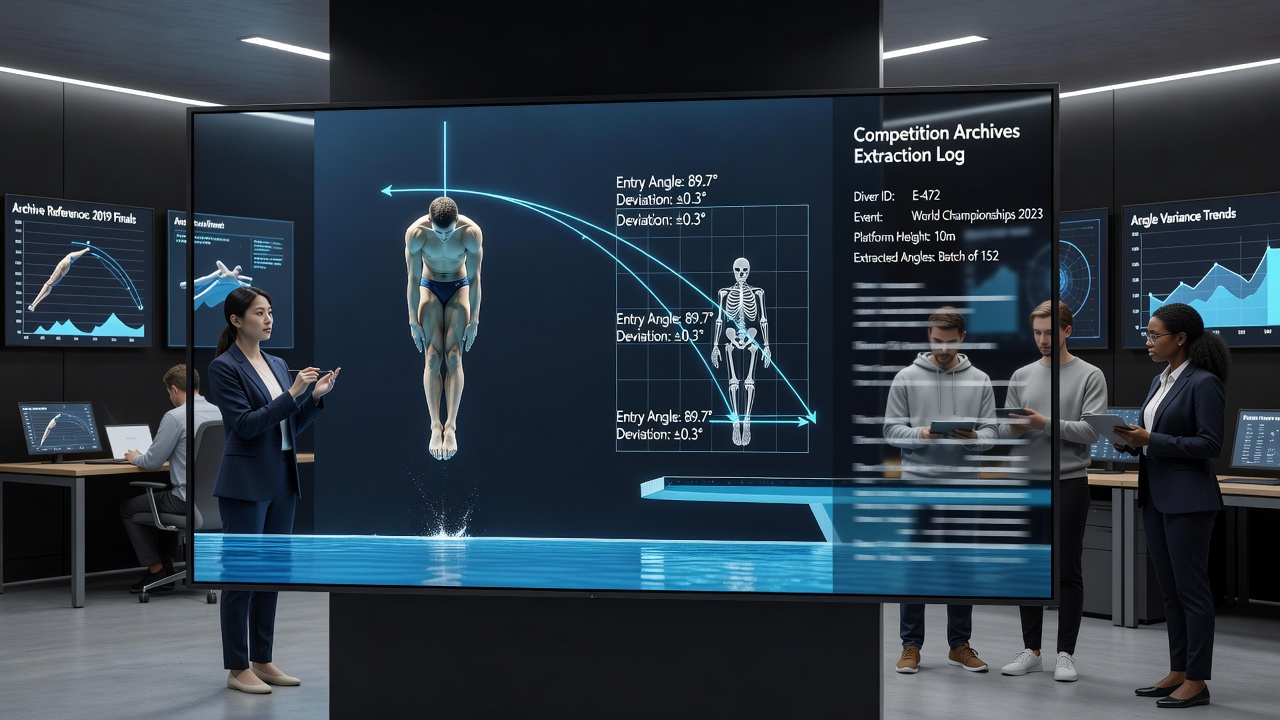
Additional processing steps include synchronization of overhead footage with poolside cameras to verify the exact frame of water contact and this dual-camera validation reduces measurement error to less than one degree according to validation tests performed by European sports research groups. The resulting datasets feed into athlete feedback systems where coaches review angle trends over multiple meets and adjust training drills accordingly.
Integration with Training Protocols
National teams have begun incorporating overhead-derived angle reports into weekly review meetings and divers receive visual overlays that illustrate how small deviations affect splash size and perceived entry cleanliness. In June 2026 the upcoming World Aquatics Junior Championships will serve as a new source of archival material allowing further expansion of angle databases across age groups and this expansion supports talent identification programs that track progression from junior to senior levels.
Software tools continue to evolve with machine-learning models now capable of automating initial angle detection which speeds up the workflow for large competition archives and leaves human analysts free to interpret contextual factors such as dive height and rotation count. Those who manage these systems report that the overhead method provides clearer differentiation between intentional angle adjustments and unintended errors compared with traditional side-view evaluations.
Conclusion
Overhead camera archives therefore function as a valuable repository for quantifying entry precision in platform diving and the extracted metrics offer objective benchmarks that complement subjective judging criteria. Continued refinement of extraction techniques ensures that future competitions will yield even richer datasets for performance analysis while maintaining compatibility with existing training frameworks.