The Role of Thermal Imaging in Detecting Muscle Fatigue Patterns Among Elite Sprinters During Evening Meets
Written by Katja Brooks · Jun 27, 2026

The Role of Thermal Imaging in Detecting Muscle Fatigue Patterns Among Elite Sprinters During Evening Meets
Thermal imaging captures infrared radiation emitted from the skin surface and converts those readings into detailed temperature maps that highlight variations across muscle groups. Researchers have applied this technology to track how fatigue develops in elite sprinters, particularly when competitions occur in the evening hours when core body temperatures naturally rise and circadian rhythms influence performance variables. Data collected from multiple international meets shows consistent patterns where quadriceps and hamstring regions display progressive cooling as glycogen stores deplete and blood flow redistributes during repeated high-intensity efforts. Evening meets introduce additional variables because ambient temperatures often drop after sunset while athletes maintain elevated internal heat from warm-ups and prior heats. Studies conducted at major athletics events indicate that these conditions accelerate detectable shifts in surface temperature across the posterior chain, allowing observers to identify localized fatigue before visible performance drops occur. Equipment operators position cameras at finish-line zones and recovery areas to capture sequential scans that align with split times and heart-rate telemetry for integrated analysis.Technology Fundamentals and Measurement Protocols
High-resolution thermal cameras operate in the 8-14 micrometer wavelength range and achieve accuracy within 0.1 degrees Celsius when calibrated against blackbody references before each session. Teams follow standardized protocols that require athletes to stand in controlled postures for 30 seconds immediately after crossing the finish line, minimizing motion artifacts and ensuring comparable data sets across competitors. Software then segments regions of interest around major muscle groups and calculates mean temperature, standard deviation, and asymmetry indices that flag potential fatigue hotspots.
Calibration routines also account for skin emissivity differences and environmental factors such as humidity and wind speed, both of which fluctuate during evening sessions. Research groups have published protocols through the European College of Sport Science that detail these adjustments, enabling consistent results when multiple venues host back-to-back competitions.
Patterns Observed in Elite Competition
Analysis of footage from championship meets reveals that hamstring temperatures often decline by 1.2 to 1.8 degrees Celsius within the first 90 seconds of recovery in athletes who have completed multiple rounds on the same evening. This cooling correlates with elevated lactate levels measured in parallel blood samples and precedes measurable reductions in stride frequency during subsequent races. Quadriceps regions, by contrast, maintain higher temperatures longer because of their role in maintaining posture during the deceleration phase at the finish line.
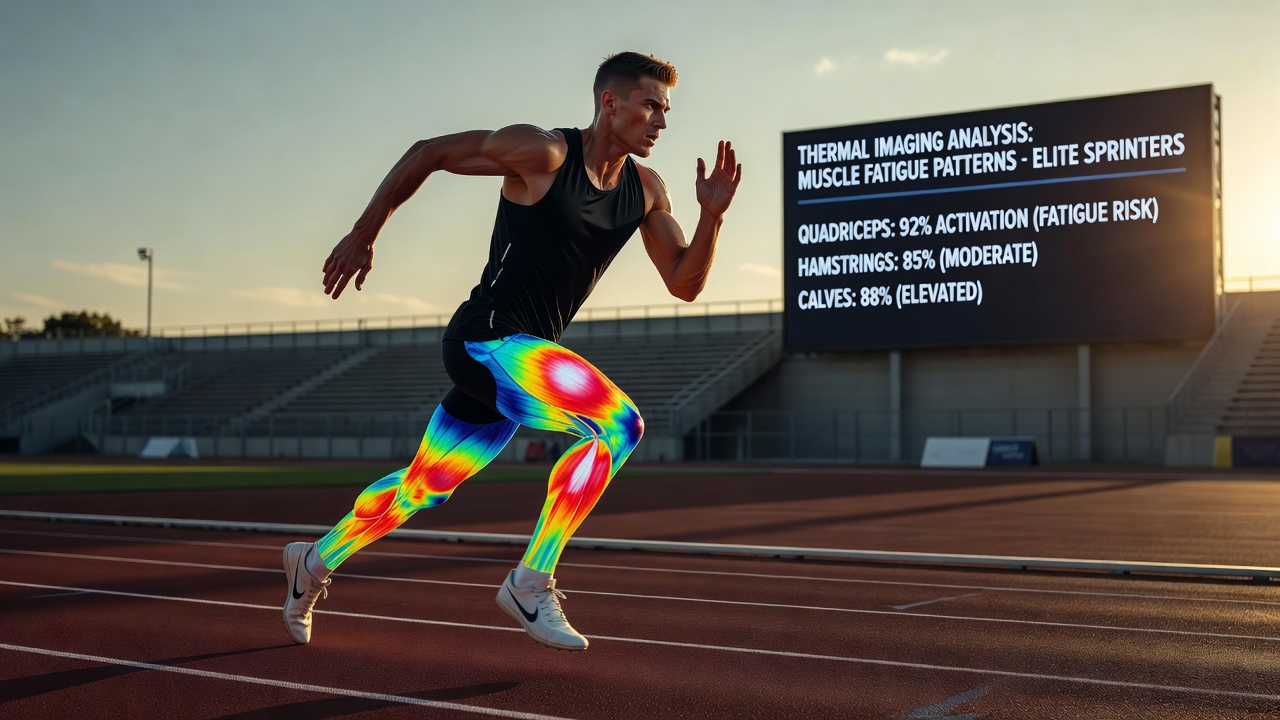
One study presented at the 2025 World Athletics Science Congress tracked 28 sprinters across three consecutive evening sessions and documented bilateral asymmetry increases exceeding 0.7 degrees Celsius in athletes who later reported delayed-onset muscle soreness. These findings prompted coaching staff to adjust recovery protocols, including targeted contrast baths and compression timing, before the next round of heats.
Integration with Other Performance Metrics
Thermal data gains additional value when synchronized with GPS-derived stride parameters and force-plate measurements collected during training blocks that replicate evening-meet schedules. Analysts overlay temperature maps onto three-dimensional motion models to pinpoint whether reduced hip extension coincides with localized cooling in the gluteal region. Such combined datasets have been referenced in reports from the Australian Institute of Sport, where staff use the information to schedule individualized recovery windows between rounds.
Evening conditions also affect camera placement because lower light levels require supplemental infrared illumination that does not interfere with athlete vision or timing systems. Organizers at the 2026 European Athletics Championships in June implemented mobile thermal stations positioned 15 meters beyond the finish line, allowing non-intrusive scans while athletes remained in their competition lanes.
Data Processing and Predictive Applications
Machine-learning algorithms trained on multi-meet datasets now classify fatigue stages with reported accuracy above 82 percent when temperature gradients, asymmetry scores, and time-since-warm-up are included as input variables. These models help medical teams decide whether an athlete should proceed to the next round or receive additional monitoring. Processing pipelines run on edge-computing units at trackside so results reach coaches within four minutes of each race conclusion.
Longitudinal tracking across an entire outdoor season shows that sprinters who exhibit rapid temperature recovery between rounds maintain higher average placing percentages in evening finals. Federations such as Athletics Canada have incorporated thermal screening thresholds into their athlete-monitoring guidelines, requiring documented scans before athletes advance from semi-finals to finals in night sessions.
Conclusion
Thermal imaging supplies objective, non-invasive indicators of muscle fatigue that complement traditional physiological measures during evening sprint competitions. Continued refinement of calibration standards and integration with existing performance technologies supports broader adoption at elite meets scheduled for June 2026 and beyond. The method delivers repeatable data that coaching and medical staff use to inform real-time decisions while athletes navigate the unique demands of late-day racing schedules.