Timing the perfect discus spin: torque shifts captured in elite thrower footage from global meets
Written by Yves Simon · Jun 29, 2026
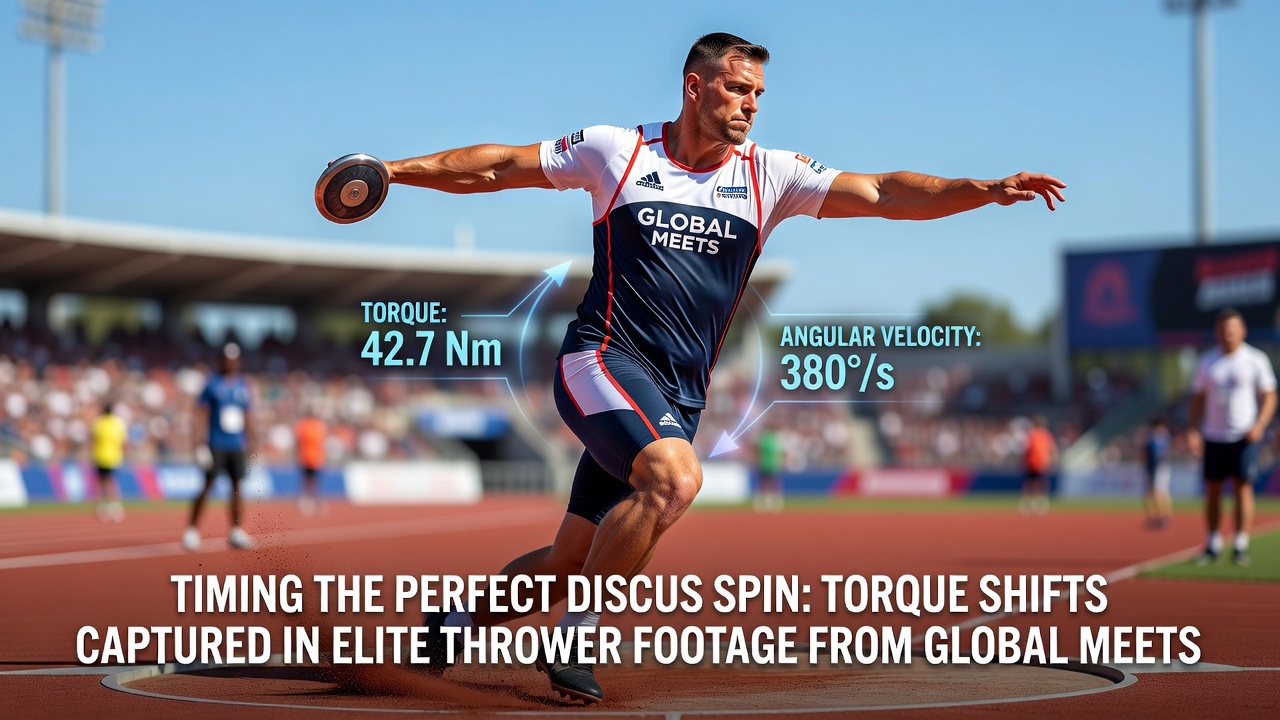
Timing the perfect discus spin: torque shifts captured in elite thrower footage from global meets
Elite discus throwers generate power through precise rotational timing that shifts torque across the kinetic chain, and analysts have examined high-speed footage from meets worldwide to map these sequences. Data from World Athletics events shows that the transition from the first turn to the power position lasts between 0.35 and 0.45 seconds in top performers, while torque peaks occur when the hips lead the shoulders by 30 to 40 degrees. Researchers at the Australian Institute of Sport have documented these patterns through synchronized multi-angle recordings that reveal how small adjustments in foot placement alter force application at release.
Mechanics of rotational torque in the discus spin
Throwers initiate the spin from a balanced stance at the back of the circle, then drive the left foot across the center line to establish the double-support phase. During this interval the ground reaction forces create a twisting moment that accelerates the implement, and footage from the 2023 World Championships illustrates how elite athletes maintain a low center of mass while the right knee drives upward. The shift in torque becomes visible when the left arm opens and the right hip rotates ahead of the upper body, producing a stretch-shortening cycle in the obliques and latissimus dorsi. Studies indicate that the final delivery phase accounts for approximately 60 percent of total release velocity, with angular momentum transferred through the shoulder girdle in under 0.15 seconds.
Frame-by-frame analysis from international competition archives
Video captured at the Tokyo Olympic Stadium and the Eugene Diamond League meets provides consistent reference points for torque timing. In one sequence an athlete completes the wind-up with the discus held at a 35-degree angle to the horizontal, then accelerates through the turn while the left foot plants at the 10 o'clock position relative to the throwing direction. Observers note that any delay in hip rotation beyond 0.08 seconds after foot plant reduces the subsequent shoulder whip and lowers release speed by 1.2 meters per second on average. Motion-capture overlays from these events demonstrate how the non-throwing arm tucks to conserve angular momentum before extending to counterbalance the implement at release.
Comparative data across athlete cohorts
Performance records compiled by European athletics federations reveal measurable differences between medalists and finalists. Athletes finishing in the top three at major championships exhibit a 12 percent greater peak torque during the second turn compared with those placing fourth through eighth, according to synchronized force-plate and video measurements. Training logs from Canadian national team programs show that drills emphasizing delayed shoulder rotation after hip drive improve consistency at release, while South African biomechanists have tracked similar gains through repeated review of competition footage. The pattern holds across both male and female competitors, though absolute values differ by roughly 15 percent due to variations in implement mass and body segment lengths.

Application to training and preparation cycles
Coaches integrate these video-derived metrics into periodized programs that peak before major competitions. Sessions conducted in the lead-up to June 2026 continental championships include targeted cueing of the left-foot plant timing, with athletes reviewing their own spins against reference footage within 24 hours. Resistance bands and medicine-ball rotational throws replicate the torque sequence at slower speeds, allowing neuromuscular adaptation before full-speed repetitions resume. Data collected at training centers in Germany and Japan indicate that athletes who review torque-shift overlays weekly reduce variability in release angle by 4 degrees over an eight-week block.
Conclusion
Footage from global meets continues to supply the clearest evidence for optimizing discus spin timing and torque transfer. Analysts combine these recordings with force data to identify repeatable sequences that separate record holders from the rest of the field, and federations worldwide now incorporate such reviews into standard preparation protocols. As additional high-resolution archives become available, the precision of these measurements will support further refinements in technique across all competitive levels.